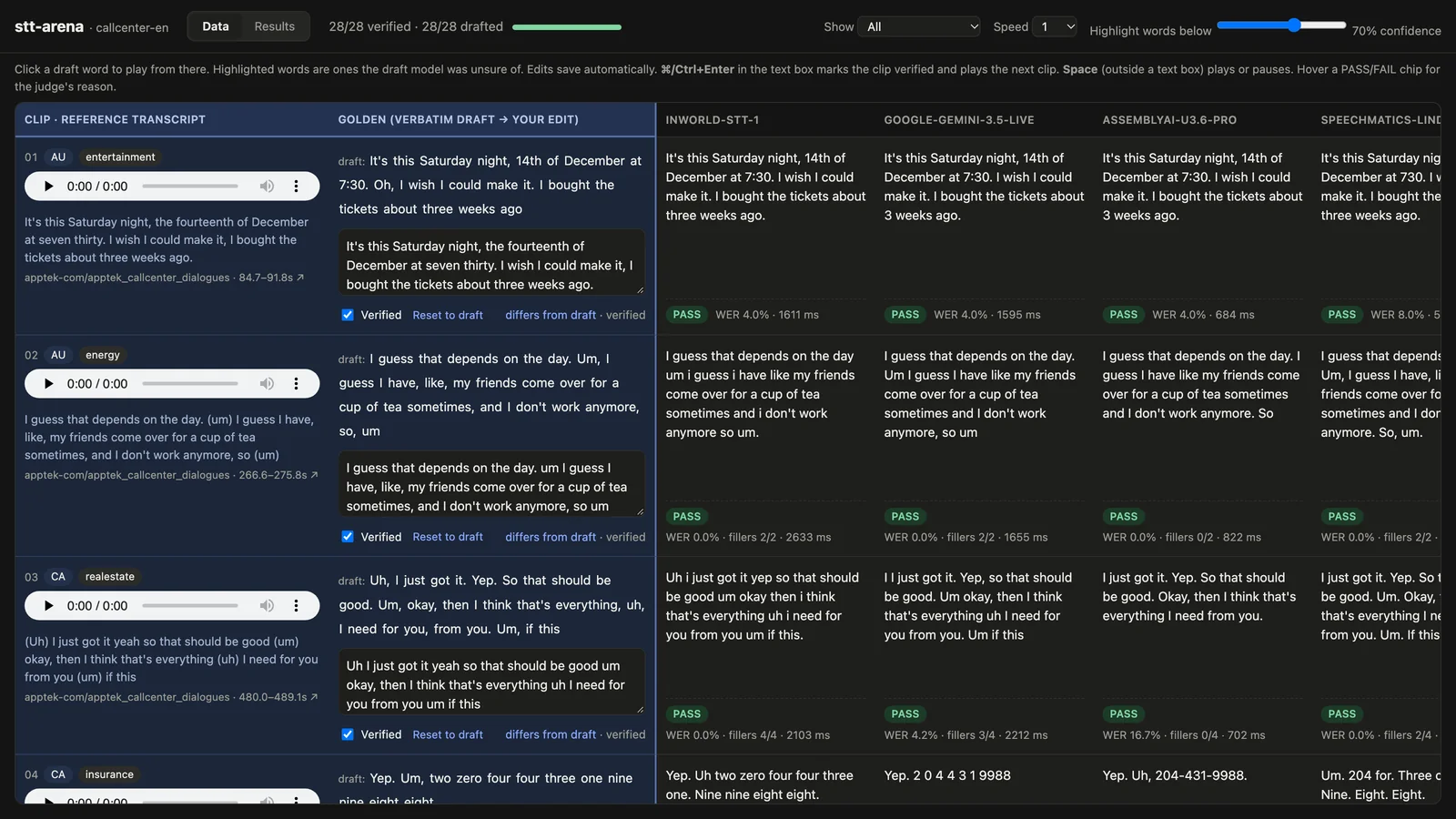
Speech-to-text leaderboards rank models by WER (= word error rate, the share of words that differ from a reference transcript) on audiobooks and earnings calls. People talking to a voice agent spell their surname, read out phone numbers and trail off mid-sentence, and a wrong letter there is a wrong customer, while WER counts it the same as a dropped “okay”.
This is a guide to evaluating streaming speech-to-text models on whether the meaning survived, with 12 models and a set of role-played support calls as the example.
In this post I’m going to:
- Pick the clips
- Make golden transcripts
- Stream every clip at real-time speed
- Judge each transcript on meaning
- Score WER, fillers, latency and cost
- Go through the results
The example set is 28 customer turns from AppTek’s open call-centre dataset, streamed through 12 models from eight providers.
Picking the clips
The dataset has role-played calls in 14 English accents, and I take two customer turns per accent. The script keeps turns between 7 and 14 seconds with at least 10 words, then prefers the ones with fillers, negations and spoken numbers, because that’s where I expected models to break.
Only the customer channel is cut, so there’s no agent crosstalk in the audio. The score is capped at 3, so one turn full of numbers doesn’t beat a turn with a number, a “not” and an “um”.
Golden transcripts
The golden is the transcript every model is compared against. A batch model (ElevenLabs Scribe) drafts a verbatim transcript, with every “um” and false start kept, and a human listens and fixes it in the dashboard. It should be a model you aren’t evaluating, otherwise the golden inherits its mistakes.
For this dataset the checked transcripts come from the dataset’s own manual transcription, with the Scribe draft kept next to each one for comparison. That comparison is a good reason for the human step: where a caller said “Linda Zhang, Z H A N G”, Scribe wrote “Linda Chang, C-H-A-N-G”.
Streaming at real-time speed
Each clip is played into each model in 20 ms frames at real-time pace, followed by 6 seconds of silence, and every final transcript is kept with its timestamps. All 12 models run through LiveKit Inference, which puts the eight providers behind one streaming interface. That’s the only reason it’s there - every model gets the same audio, the same framing and the same clock, without twelve SDKs.
The 6 seconds is there because my first run was wrong. It streamed 3 seconds of silence after each clip, and Cartesia ink-2 came back empty on 9 of 28 clips and landed dead last with 38% WER. I’d assumed 3 seconds was plenty. Its end-of-turn timeout is 5.6 seconds, so I was hanging up on it before it answered and then ranking it last for not answering. With 6 seconds, 2 of those 9 came back and 7 didn’t, which is why I trust the 7 as a finding about the model.
Latency is end of speech to the last final transcript. Turn-aware models (Deepgram Flux, Cartesia ink-2, AssemblyAI’s universal-3-6-pro, Inworld) send a final only once they’ve decided the turn is over, so their number includes a turn-taking decision. Phrase-level models like nova finalise each phrase in about 300 ms, but a voice agent then runs its own turn detector on top. If latency is what decides it, the number to measure is end of speech to agent reply, which this harness doesn’t do.
The LLM judge
The judge reads the golden and every model’s transcript for one clip, and returns PASS or FAIL per model with a reason. For this dataset the question is: would a support agent understand the customer the same way? A lost “not”, a wrong digit or a wrong name fails. A missing “um”, punctuation, or “7:30” for “seven thirty” doesn’t. The binary verdict and the habit of reading the data before trusting a number come from Hamel Husain’s Your AI Product Needs Evals.
The judge is a model too. It failed “Britney” for “Brittany”, which is right if the agent types the name into a CRM and pedantic otherwise imo. Every FAIL quotes the two spans it compared, so the verdicts can be checked, and where I disagree the fix is a clearer rubric in prompts/judge.md.
Scoring
WER, filler recall (= how many of the speaker’s ums survived), latency and cost are computed alongside the verdicts. Before WER, both sides are normalised so fillers and number formatting don’t count as errors.
Results
| Model | Judge pass | WER | Fillers kept | Latency p50 | $/min |
|---|---|---|---|---|---|
| Inworld stt-1 | 25/28 | 7.9% | 88% | 1767 ms | 0.0017 |
| Google gemini-3.5-transcribe-live | 25/28 | 9.3% | 52% | 1661 ms | 0.0095 |
| AssemblyAI universal-3-6-pro | 25/28 | 10.2% | 29% | 628 ms | 0.0075 |
| Speechmatics linden-1 | 25/28 | 11.0% | 77% | 649 ms | 0.0050 |
| Deepgram nova-2 | 23/28 | 9.8% | 71% | 295 ms | 0.0047 |
| xAI stt-2 | 20/28 | 10.5% | 0% | 913 ms | 0.0033 |
| Deepgram nova-3 | 19/28 | 10.5% | 7% | 296 ms | 0.0042 |
| OpenAI gpt-live-transcribe | 19/28 | 12.0% | 54% | 1091 ms | 0.0170 |
| Deepgram flux-general-en | 18/28 | 11.3% | 43% | 1003 ms | 0.0057 |
| Cartesia ink-whisper | 18/28 | 14.9% | 12% | 304 ms | 0.0023 |
| AssemblyAI universal-streaming | 18/28 | 16.6% | 0% | 701 ms | 0.0025 |
| Cartesia ink-2 | 17/28 | 32.5% | 59% | 884 ms | 0.0068 |
One run in June 2026 on 28 English role-played support calls, with prices from LiveKit Inference’s Scale tier. That’s enough to see that a model drops every filler or mangles digits, not enough to separate 89% from 86%: a difference of one or two clips is noise.
Numbers and names are where it breaks
41 of the 84 failures were a wrong digit, a garbled name or a mangled spelling. A caller says “my name is Linda Zhang, Z H A N G”. Deepgram’s nova-2 writes “c h a n g”. Inworld’s stt-1 gets the spelling right and writes “dates” where the caller said “days”. On WER the two score the same on that clip, 11.5%. It wasn’t a one-off: five of the twelve models wrote “C H A N G”. Another caller reads out “two zero four four three one nine nine eight eight” and one model returns “204-431. 9922”, another “Choose your four three one nine nine eight eight”. If your agent takes account numbers, test account numbers.
Four models tie, and they’re nothing alike
Inworld, Gemini, AssemblyAI’s universal-3-6-pro and Speechmatics each kept the meaning on 25 of 28 clips. Inworld is the cheapest model in the table and keeps almost every “um”, but it’s English-only and takes about 1.8 seconds to finalise. AssemblyAI and Speechmatics answer in about 650 ms and are multilingual. Gemini costs over 5x what Inworld does. So the judge only tells me who’s good enough, and latency, price and language coverage pick between them.
Newer wasn’t better
Deepgram’s nova-3 passed fewer clips than the older nova-2 (19 vs 23) and kept 4 of 56 fillers where nova-2 kept 40. Both finalise in about 300 ms, the fastest here. I’d assumed the newer model would just be the better one. On different audio it might be, which is the reason to run this on your own clips.
Some models delete every “um”
xAI’s model and AssemblyAI’s universal-streaming kept 0 of 56 fillers. For a search box that’s fine. For an agent that should notice hesitation, the model is throwing away input.
A turn-aware model can go quiet
Cartesia’s ink-2 decides for itself when the speaker has finished. On 7 clips where the speaker trailed off (“…and I don’t work anymore, so um”) it never committed the turn, even after 6 seconds of silence. Live, that turn would hang until the user spoke again.
WER and the judge disagree
Speechmatics has a worse WER than nova-3 (11.0% vs 10.5%) and passes six more clips. One wrong “not” barely moves WER and changes what the customer said. A dropped “okay” moves WER and changes nothing.
The clips, the checked transcripts, every model’s raw output and the steps to run it on your own audio are in STT Arena.