Speech recognition models often fail on children’s slurred words. They either misspell them or output words that sound similar but are unrelated, which can change the meaning of the whole sentence.
This is a guide to how the different parts of a speech model contribute to recognising children’s speech, and to training only the parts that matter.
In this post I’m going to:
- Lay out the pipeline
- Prepare the data and reproduce the published split
- Score the way DrivenData did
- Run baselines and a reference fine-tune
- Choose what trains
- Compare with a model that has no decoder
- Read the weight changes
- Go through the results
Solution overview
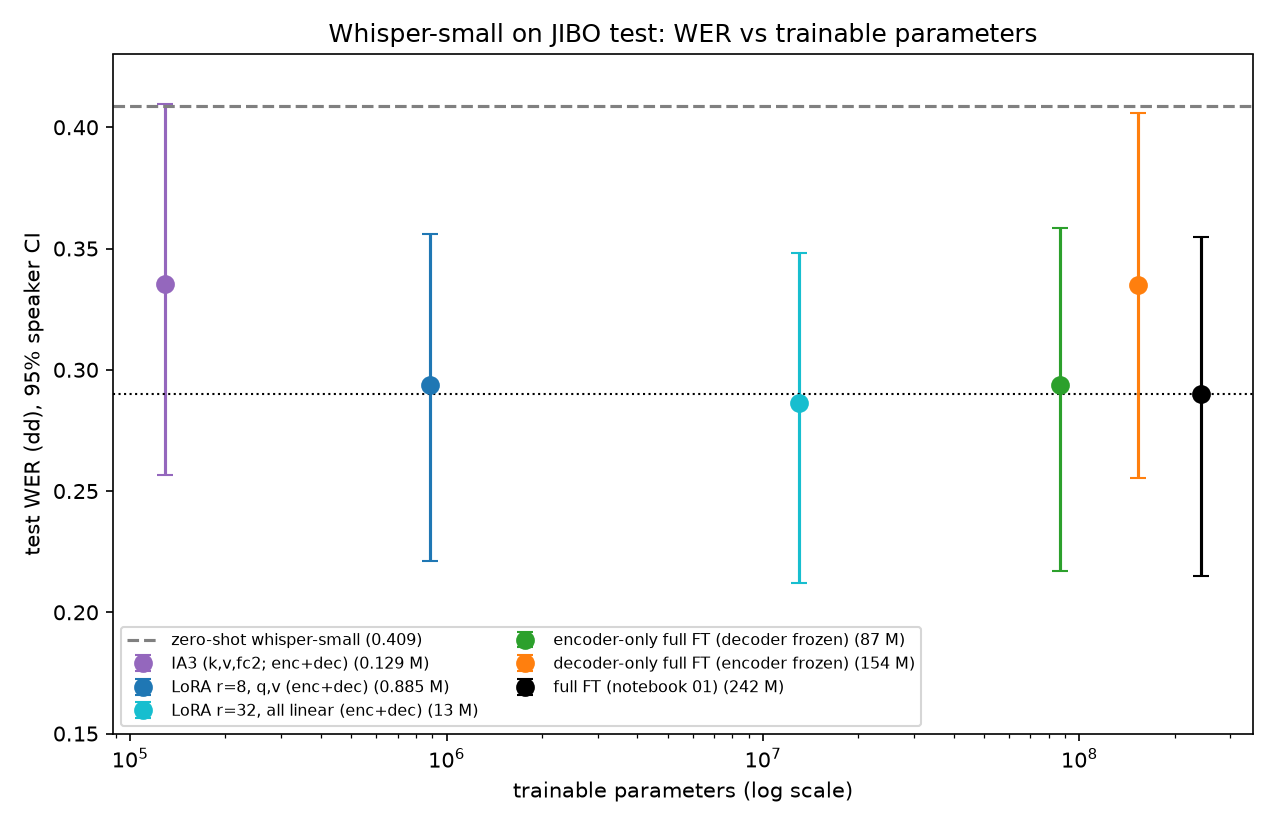
Whisper has an encoder (= turns the audio into a representation) and a decoder (= a language model that writes the transcript, reading the encoder’s output through cross-attention). I fine-tuned Whisper-small on the JIBO children, then kept that recipe fixed and trained each half on its own, plus a few adapter variants, and read the weight changes afterwards. Training only the encoder recovered 97% of the full fine-tune’s gain in WER (= word error rate, the share of reference words the model got wrong, counting substitutions, deletions and insertions) with 87M trainable parameters. Training only the decoder, with 154M, recovered 62%. On this data, the part that matters is how the audio is heard, not how the text is written.
Full fine-tune
Every weight trains.
Encoder only
Decoder frozen.
Decoder only
Encoder frozen.
The work runs in six stages:
- Cut the JIBO Kids session recordings into utterances, and reproduce the corpus authors’ ESPnet train/dev/test split exactly.
- Score with the normaliser from DrivenData’s 2026 children’s speech recognition challenge, so the numbers mean what the challenge’s would have, and put a speaker-level confidence interval on each one.
- Run zero-shot baselines, then one full fine-tune of Whisper-small as the reference.
- Keep that recipe fixed and change only what’s trainable: encoder only, decoder only, LoRA at two sizes, and IA³.
- Fine-tune a CTC model (wav2vec2) the same way, to see what a model without a decoder does.
- Diff every fine-tuned checkpoint against the base weights.
Stage 1: Data and the split
Segmenting the sessions
JIBO Kids (UCLA, CC BY 4.0) is 110 children from pre-K to grade 1, aged about 4 to 7, talking to a social robot at school. It ships as 383 long session WAVs (21.1 hours), with each transcript line giving a start time, an end time and the words. Cutting each line out gives 8,489 utterances and 6.27 hours of child speech, with a median length of 1.3 seconds.
The tasks are uneven. Letters-and-digits is 72% of the utterances but only 36% of the words, since most answers are one letter. The transcribers also wrote down what the child actually said, mispronunciations included (“IF YOU PORTEN” for “important”), so a model that writes the intended word gets penalised.
Reproducing ESPnet’s split
The JIBO paper doesn’t define a split, and the only published ASR numbers on this corpus come from the authors’ ESPnet recipe. That recipe holds out speakers with Kaldi’s subset_data_dir_tr_cv.sh, which shuffles them with a Perl script. Perl’s rand has been drand48 everywhere since 5.20, so calling the original script with the system Perl reproduces the shuffle without installing ESPnet.
def kaldi_split(speakers, pct, srand):
    """(trn, cv) speaker lists exactly as Kaldi's subset_data_dir_tr_cv.sh would make them."""
    shuf = subprocess.run(["perl", "tools/kaldi_utils/shuffle_list.pl", "--srand", str(srand)],
                          input="\n".join(sorted(speakers)) + "\n",
                          capture_output=True, text=True, check=True).stdout.split()
    n_cv = int(pct * len(shuf) / 100)
    return shuf[n_cv:], shuf[:n_cv]

train_spk, heldout = kaldi_split(utts.spk.unique(), 25, srand=777)
test_spk, dev_spk = kaldi_split(heldout, 50, srand=777)
# split  children  utts  words
# train        83  6592  23678
# dev          13   853   2372
# test         14  1044   3686
The test and dev counts match ESPnet’s RESULTS.md exactly, so every number here sits on the same 14 test children as the published baselines. For training I kept the 6,490 train segments between 0.3 and 25 seconds that weren’t empty or near-silent (4.42 hours).
Stage 2: Scoring like DrivenData
DrivenData’s score_wer runs Whisper’s EnglishTextNormalizer with the open_asr_leaderboard spelling map on both sides, then computes corpus WER. I vendored the spelling map and computed WER from per-utterance edit counts, so I could slice by grade or task and resample children.
from kidsasr.metrics import norm_dd, utterance_errors, corpus_wer

norm_dd("TWO.")    # '2'
norm_dd("DON'T")   # 'do not'
err = utterance_errors(["C.", "TWO."], ["See.", "2"], scorer="dd")
corpus_wer(err)    # 0.5 - "see" for "c" is still a substitution
The normaliser doesn’t map letter names, so “see” for “C” counts as an error. That’s fair, imo, since the child said a letter. With only 14 test children, the confidence intervals come from a speaker bootstrap (= resample the children with replacement, 2,000 times), and comparisons between two models use a paired version of it on the same draws.
Stage 3: Baselines
Zero-shot
| Model | Test WER |
|---|---|
| Whisper-large-v3 | 0.352 |
| KidWhisper-medium (MyST + CSLU) | 0.355 |
| Whisper-large-v3-turbo | 0.356 |
| Parakeet-TDT-0.6b-v3 | 0.383 |
| Whisper-small | 0.409 |
| Whisper-small fine-tuned on OGI kids | 0.750 |
Bigger Whisper helps. Checkpoints fine-tuned on older children mostly don’t: KidWhisper-small and a MyST fine-tune of Whisper-small score 0.412 and 0.402, no better than plain Whisper-small. The OGI checkpoint learned mostly isolated scripted words, and it shows: one child’s “Y” becomes “wiseguy”, another’s “T” becomes “toyota”.
I didn’t run DrivenData’s own pasketti-word model. Its training data included JIBO Kids, with 81 of about 109 children in their train split, so most of my test children were probably in it. It’s the in-domain reference I’d want, but its score wouldn’t mean what the others do.
The reference fine-tune
The reference is a full fine-tune of Whisper-small (241.7M parameters): AdamW at 1e-5, 821 steps (about 2 epochs, 72 minutes), with SpecAugment and ±10% speed perturbation, the best checkpoint picked on dev, and test scored once. It went from 0.409 to 0.290 [0.215, 0.355]. That beats zero-shot Whisper-large-v3 by 0.062, though the paired interval only just clears zero.
Stage 4: Choosing what trains
Everything from the reference run stays fixed: data, augmentation, batch size, step count, evaluation and decoding. Only the set of trainable weights and the learning rate change.
Freezing half of Whisper
For the partial fine-tunes I freeze everything, then unfreeze one half.
m = WhisperForConditionalGeneration.from_pretrained("openai/whisper-small")
keep = m.model.encoder                  # m.model.decoder for the decoder-only run
for p in m.parameters():
    p.requires_grad_(False)
for p in keep.parameters():
    p.requires_grad_(True)
m.model.encoder.embed_positions.requires_grad_(False)   # fixed sinusoids
# encoder-only: 87,002,112 trainable | decoder-only: 153,580,800
The decoder is the bigger half because 39.8M of its parameters are the token embedding, which is tied to the output layer. So decoder-only also trains what the model can write.
Adapters
LoRA (= a trainable low-rank update B·A added to a frozen weight matrix) and IA³ (= learned per-channel scaling vectors) come from peft.
from peft import LoraConfig, IA3Config, get_peft_model

lora_r8 = LoraConfig(r=8, lora_alpha=16, lora_dropout=0.05,
                     target_modules=["q_proj", "v_proj"], bias="none")
m = get_peft_model(make_base_model(), lora_r8)
m.print_trainable_parameters()
# trainable params: 884,736 || all params: 242,619,648 || trainable%: 0.3647

ia3 = IA3Config(target_modules=["k_proj", "v_proj", "fc2"], feedforward_modules=["fc2"])
# trainable params: 129,024
The second LoRA is r=32 on every linear layer (q, k, v, out, fc1, fc2), 13.0M parameters. Both LoRAs touch the encoder and the decoder.
Training arguments
Seq2SeqTrainingArguments(
    per_device_train_batch_size=8, gradient_accumulation_steps=2,   # effective batch 16
    learning_rate=lr,       # 1e-5 full/partial, 1e-3 LoRA r8, 1e-4 LoRA r32, 3e-3 IA3
    lr_scheduler_type="linear", warmup_steps=82, max_steps=821,
    gradient_checkpointing=True, fp16=True,
    eval_strategy="steps", eval_steps=164, predict_with_generate=True,
    metric_for_best_model="wer", greater_is_better=False,
)
Each method runs in the background and writes its result as soon as it finishes.
uv run python tools/run_peft.py lora_r8_qv
# [lora_r8_qv] TEST WER(dd) 0.2939 [0.221, 0.356]
Stage 5: A model without a decoder
To see what Whisper’s decoder buys, I fully fine-tuned wav2vec2-large-960h, a CTC model (= it labels every 20 ms frame with a character on its own, with no language model), for the same 821 steps. It went from 0.669 zero-shot to 0.436, which is a bigger drop than Whisper’s but still 0.146 worse than the Whisper full fine-tune, and slightly worse than zero-shot Whisper-small (0.409).
The errors look different. 8.0% of its output words aren’t words at all (BCAUSE, LIK, two words fused into THREEIS), against 1.3% for Whisper. It also returns nothing for 35 test utterances, mostly quiet single letters where the blank symbol wins every frame, against 2 for Whisper. Whisper’s mistakes are real words that are wrong.
Stage 6: Reading the weights
No training here. I load the base and each fine-tuned checkpoint, and compare every tensor.
base = load_file(whisper_small_dir / "model.safetensors")
ft = load_file("runs/whisper-small-jibo-best/model.safetensors")
for k, w0 in base.items():
    d = ft[k].double() - w0.double()
    rel_change = d.norm() / w0.double().norm()       # ||ΔW|| / ||W||
    s = torch.linalg.svdvals(d)
    energy_top8 = (s[:8]**2).sum() / (s**2).sum()     # how rank-8-like the change is
For LoRA the change is the adapter’s product, and the cosine against the full fine-tune’s ΔW says whether they moved the same way.
dW_lora = (cfg["lora_alpha"] / cfg["r"]) * (B.double() @ A.double())
cos = dW_full.flatten() @ dW_lora.flatten() / (dW_full.norm() * dW_lora.norm())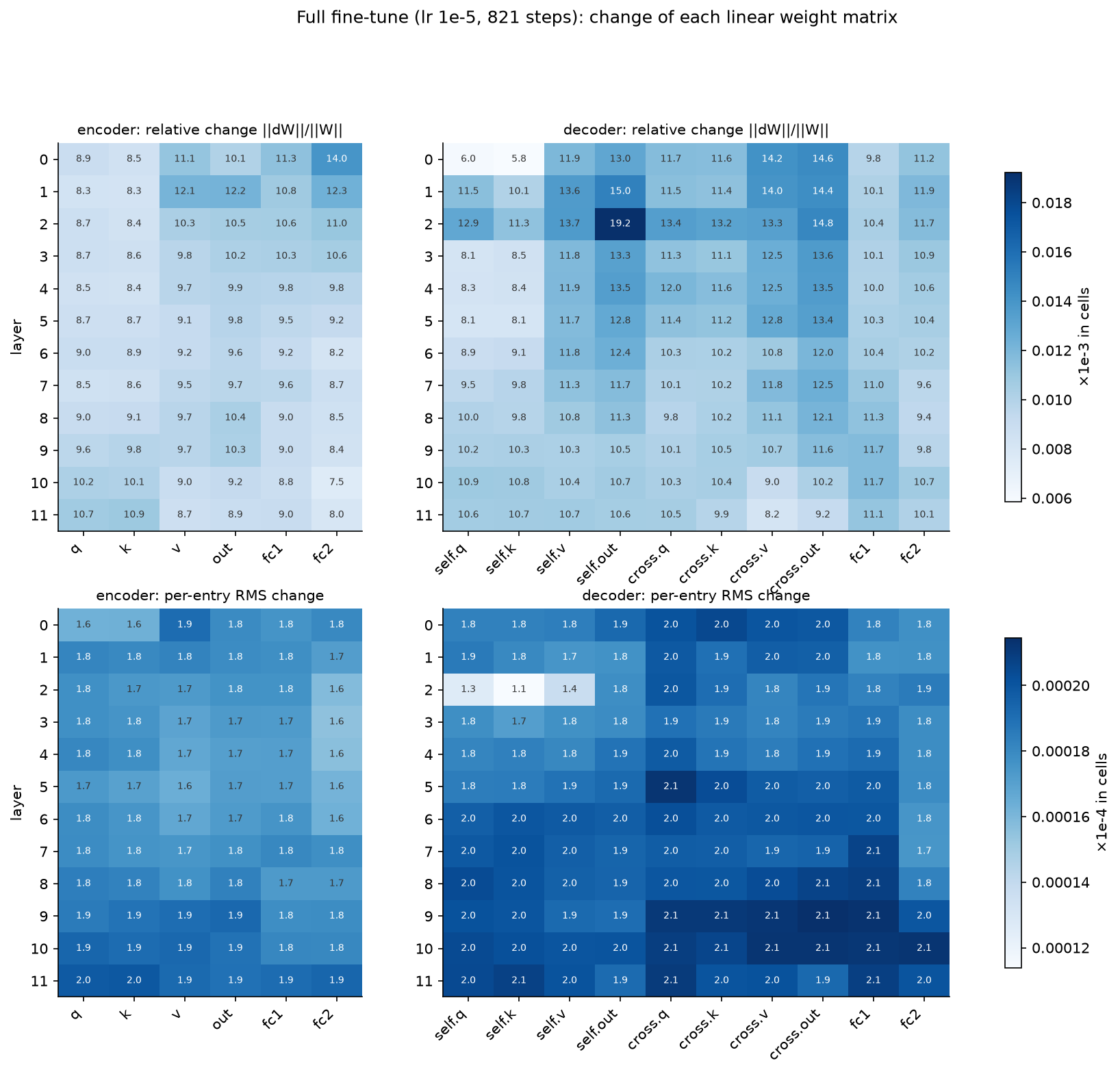
Results and validation
All numbers are test WER on the 14 ESPnet test children. Recovery is the share of the full fine-tune’s gain (0.409 to 0.290) a method keeps. With 14 children the intervals are about ±0.07 wide, and each method ran once with one seed.
| Method | Trainable | Test WER [95% CI] | Recovery | Letters/digits |
|---|---|---|---|---|
| Zero-shot Whisper-small | 0 | 0.409 [0.333, 0.492] | - | 0.734 |
| IA³ (k, v, fc2) | 0.13M | 0.336 [0.256, 0.409] | 62% | 0.356 |
| LoRA r8, q and v | 0.88M | 0.294 [0.221, 0.356] | 97% | 0.338 |
| LoRA r32, all linear | 13.0M | 0.286 [0.212, 0.348] | 103% | 0.341 |
| Encoder-only | 87.0M | 0.294 [0.217, 0.358] | 97% | 0.349 |
| Decoder-only | 153.6M | 0.335 [0.256, 0.406] | 62% | 0.427 |
| Full fine-tune | 241.7M | 0.290 [0.215, 0.355] | 100% | 0.346 |
| wav2vec2 CTC full fine-tune | 311M | 0.436 [0.361, 0.511] | - | 0.493 |
The encoder is where children’s speech gets fixed
Encoder-only lands within 0.004 of the full fine-tune, and the paired interval includes zero. Decoder-only trains more parameters and ends 0.045 [0.020, 0.076] worse, losing in all 2,000 bootstrap draws. The decoder can learn JIBO’s output format (spelled letters, digits as words), and it does get letters/digits from 0.734 to 0.427. It can’t change how a four-year-old’s voice is heard.
Parameter count isn’t the axis
LoRA r8 trains 0.37% of the model and lands with the full fine-tune. IA³ (0.13M) and decoder-only (154M) land together at about 0.335. What the methods at 0.29 share is that they can change the encoder’s attention. IA³ can only rescale channels, and decoder-only can’t touch the encoder at all.
Almost all the gain is on letters
A kindergartner is asked to name a letter. She says “C”, and zero-shot Whisper-small writes “See.” Another child says “Y” and gets “Why?”, and “I” comes out as “Bye.” That task is where fine-tuning pays: the full fine-tune takes letters/digits from 0.734 to 0.346. On the explanation tasks it barely moves them (0.279 to 0.268). IA³ (0.327) and decoder-only (0.298) make the explanation tasks worse than zero-shot, which I read as them being pushed hard towards the letters format and losing some of Whisper’s open vocabulary.
The decoder moved more, and mattered less
In the full fine-tune the decoder’s linear layers changed by 1.06% and the encoder’s by 0.94%. If I’d only had the weights, I’d have guessed the decoder did more of the work. The token embedding’s change, once a shift shared by every row is removed (88% of it, which the softmax ignores), sits on single capital letters and child-robot words like “see” and “Bye”. So the decoder’s change looks like format, and the encoder’s smaller change is the part nothing else can do.
The change is low-rank, but LoRA didn’t copy it
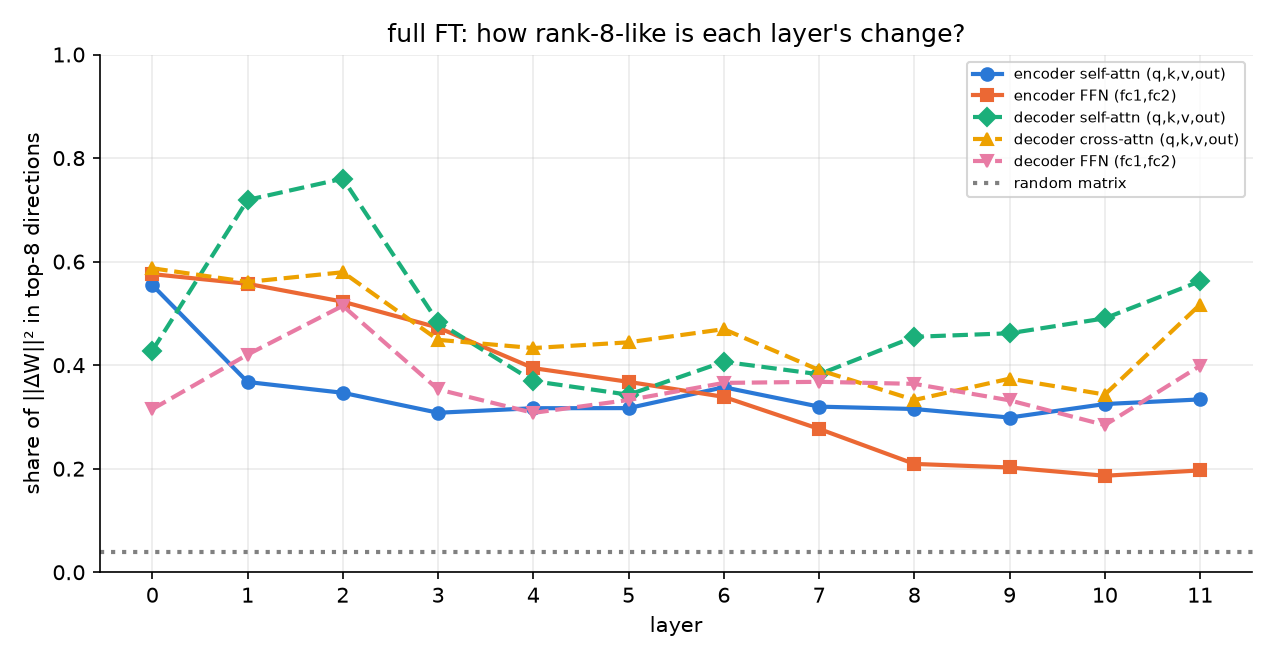
The top 8 singular directions hold 33 to 46% of the full fine-tune’s change (median by block), against 4% for a random matrix. It’s most concentrated in encoder layer 0 (0.58 to 0.69 for q, v and fc2) and in decoder cross-attention q (0.45 to 0.73 in every layer). A single coherent direction is what a systematic shift like children’s higher pitch would produce, though I haven’t tested that.
I’d assumed this was why LoRA works. The weights don’t say that. LoRA r8’s ΔW has a median cosine of 0.11 to 0.14 with the full fine-tune’s, where a rank-8 matrix could have reached 0.58 to 0.69. It found a different solution of similar quality, not a compressed copy.
Smaller adapters save storage, not time
LoRA, IA³ and encoder-only took 4.3 to 5.2 seconds per step, against 4.9 for the full fine-tune, because the backward pass still goes through the whole encoder. The saving is the file: 3.5 MB for the LoRA r8 adapter against a 967 MB model. Only decoder-only was fast (0.8 s/step), and it’s one of the two weak methods.
The code, the four notebooks with their outputs, and every model’s test predictions are in the repo: data and baselines, what to train, CTC and weight changes.